Portland ran on Columbia South Shore Well Field groundwater from August 4 to August 21, 2026, and the Water Bureau said the return to 100 percent Bull Run water could take up to two weeks to reach every tap. If your water still seems different, compare several cold-water taps before treating the difference as a permanent filtration or softening problem.
Why Portland water can still seem different after the switch
The Water Bureau used the Columbia South Shore Well Field during routine maintenance beginning August 4. Its August 21 Bull Run update says the return travels through the distribution system at different rates. A temporary change in taste, smell, or rinse feel during that period does not by itself show that your home needs treatment equipment.
The source waters are measurably different. Portland's 2026 Drinking Water Quality Report lists Bull Run hardness at 7 to 11 parts per million, about 0.5 grains per gallon, and groundwater hardness at about 80 parts per million, or about 5 grains per gallon. That difference can help explain why water may not feel exactly the same while the system changes sources.
Before buying a filter or softener:
- Compare cold water at several taps to see whether the difference is isolated to one fixture.
- If taste or odor is strongest at first draw, clean the faucet aerator and run cold water for one to two minutes, as described in Portland's guide to taste and odor issues in drinking water.
- If the difference continues at every cold-water tap after the transition window, call the Water Quality Line at 503-823-7525. A building-specific hardness test can then show whether a softener belongs in the conversation.
Vancouver, Camas, and other Clark County addresses are on separate Washington water systems and were not part of this change.
If your skin feels tight after a shower or your hair looks dull no matter which shampoo you buy, your water could be part of the story. Hard water and those complaints sometimes occur together, but the right next step depends on the water source and what a current test shows.
Why Vancouver tap water can smell like chlorine
The City of Vancouver's 2025 water-quality report says its drinking water comes from underground aquifers and receives a trace amount of chlorine as a precaution against bacteria. The report lists chlorine results of 0.4 to 1.3 parts per million in the distribution system, below the stated maximum of 4.0 parts per million. A chlorine-like smell can therefore reflect the disinfectant residual rather than hardness, and smell alone does not show that a home needs treatment equipment.
Check the pattern before buying a filter. Note whether the smell is present at several cold-water taps, at one fixture, or only in hot water. Also confirm whether the property is served by City of Vancouver water or a private well. Those details give the utility or a plumber a better starting point if the odor is new, unusually strong, or limited to part of the plumbing system.
A water softener is not designed to remove chlorine. For chlorine taste or odor, look for a filter carrying a reduction claim for the exact model. NSF/ANSI 42 covers aesthetic claims such as chlorine taste and odor, but certification does not mean every certified product reduces every substance. Check the model's listed claim, rated flow, capacity, and replacement schedule.
What "hard water" actually is
Hard water means water carrying dissolved minerals, mostly calcium and magnesium. Hardness is a mineral-content measure; it does not identify every other water-quality concern. Hardness can vary by source and property, so test it or start with the current report from the serving utility. Soap that will not lather well and a filmy residue on glass shower doors are useful clues, not a complete diagnosis.
How hard water affects skin and hair
The minerals in hard water can react with soap and shampoo and leave residue on skin, hair, and shower surfaces. Some people describe a dry or filmy feeling, but that does not establish a medical cause. A softener or filter is not a treatment for eczema or another health condition; persistent symptoms belong with a qualified healthcare professional.
What a water softener changes
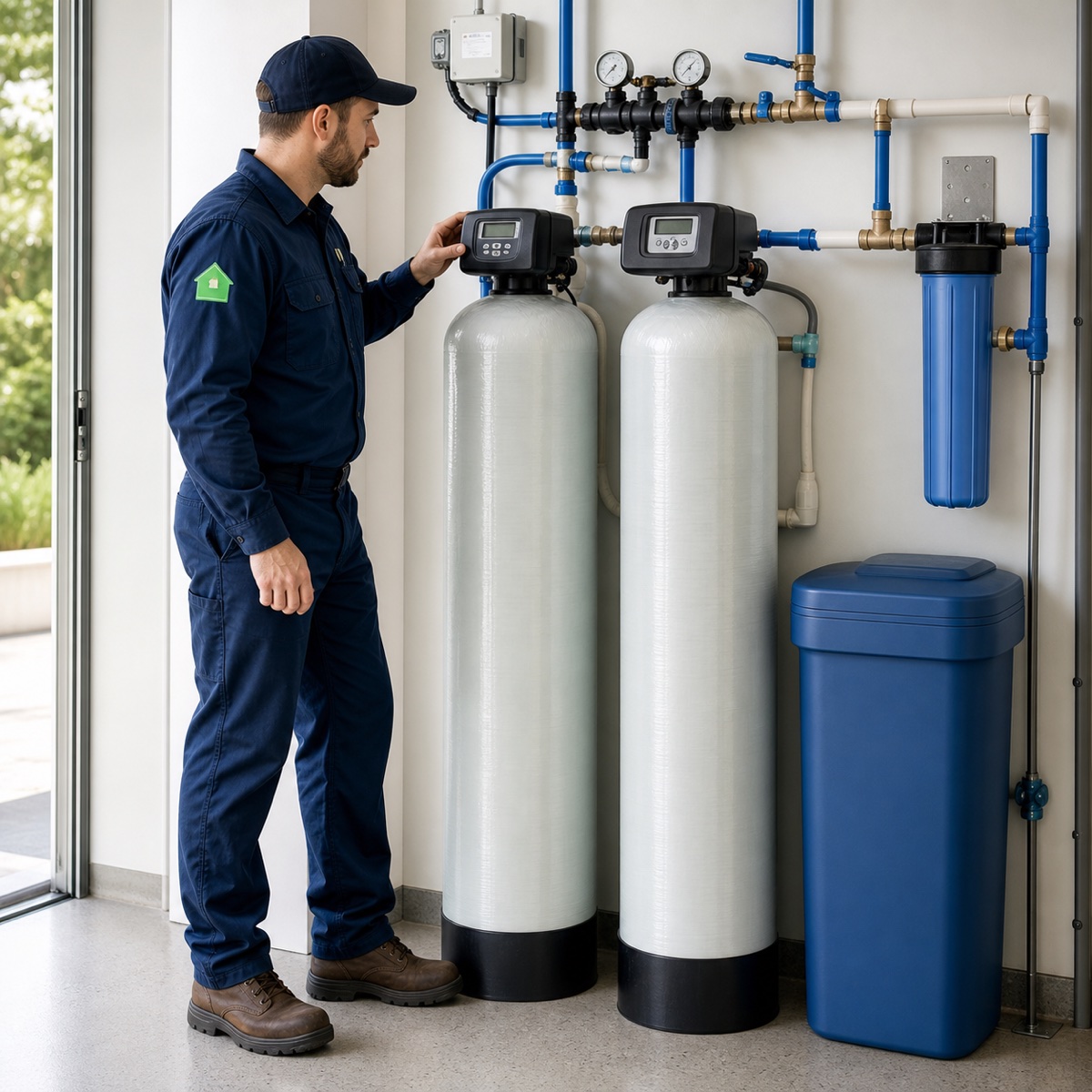
A water softener is designed to reduce hardness minerals, usually by swapping calcium and magnesium for sodium or potassium in an ion-exchange process. When a test confirms hardness is the cause of the household's scale or spotting, softening may change what you notice:
- Soap and shampoo lather more easily, so you use less
- Less residue is left behind on skin and hair after rinsing
- Reduce hardness scale inside pipes, fixtures, and water heaters
That is not a promise that every appliance will last longer or that every home with scale needs a softener. Softeners need salt or media service and maintenance, and the installation has to fit the home's water, flow, drainage, and homeowner preferences.
Where whole-home filtration fits
A softener handles hardness, but it is not a universal filter. Sediment, taste, odor, chlorine, and a health-related contaminant concern may call for different treatment, and a product should only be credited for a reduction claim supported by its treatment type and certification. A whole-home system treats the water entering the building, while point-of-use equipment treats one tap. The water source, the number of affected fixtures, and the actual target should determine which approach makes sense.
For questions about Camas water, our Camas PFAS water filtration guide covers the Well 13 notice and compares certified point-of-use and whole-home options.
Private-well water is specific to the property
Tyler Toivonen, founder of True Plumbing, describes private-well water as individual to the property rather than something that can be inferred from a town or ZIP code. A well that performs well today can change over its lifetime. In his field experience, water quality and system pressure both affect water-forward plumbing and connected equipment.
A 40/60 psi pressure-switch range is common on well systems: the pump often starts near 40 psi and stops near 60 psi. It is not universal, so the actual switch settings, tank condition, pressure at the home, and flow under demand still need to be checked. Tyler also encounters acidic or alkaline water conditions in Clark County. Water chemistry outside an appropriate range may contribute to corrosion, scale, or equipment wear in water heaters, copper piping, and fixtures.
A neutralizing system may fit a confirmed pH problem, but it is not a default prescription. Tyler's advice is to test before recommending filtration, softening, neutralization, or another treatment system. That keeps the equipment matched to the water instead of treating a guess.
Test before you buy
For municipal water, the utility's current consumer-confidence report is useful system-wide context, but it does not replace checking a building-specific complaint. For a private well, Washington State Department of Health recommends annual testing for coliform bacteria and nitrate and suggests arsenic testing during different seasons. Use a state-certified laboratory and contact the county health department when a health-related contaminant is suspected or a result needs interpretation.
Keep the target clear:
- Hardness: calcium and magnesium that can create scale and spotting
- pH: acidic or alkaline conditions that can affect corrosion and scale behavior
- Sediment: suspended particles that may clog fixtures or equipment
- Taste and odor: aesthetic concerns that may call for a different filter media
- Health-related contaminants: a separate testing and certified-treatment question, not a promise made by a generic filter
A water test does not automatically prove that a fixture or heater has failed, but it can keep the plumbing diagnosis and treatment recommendation pointed at the same cause. It is especially useful before replacing a water heater that has corroded early or failed repeatedly. The water-heater repair-versus-replacement guide explains how water and pressure conditions can change that decision.
Before buying equipment, compare the difference between supply-side mineral scale and a drain clog and the effect of water conditions on heater maintenance.
If a test identifies a problem worth treating, True Plumbing can explain the appropriate water-filtration or softening options. Call (360) 207-6064 to confirm availability.