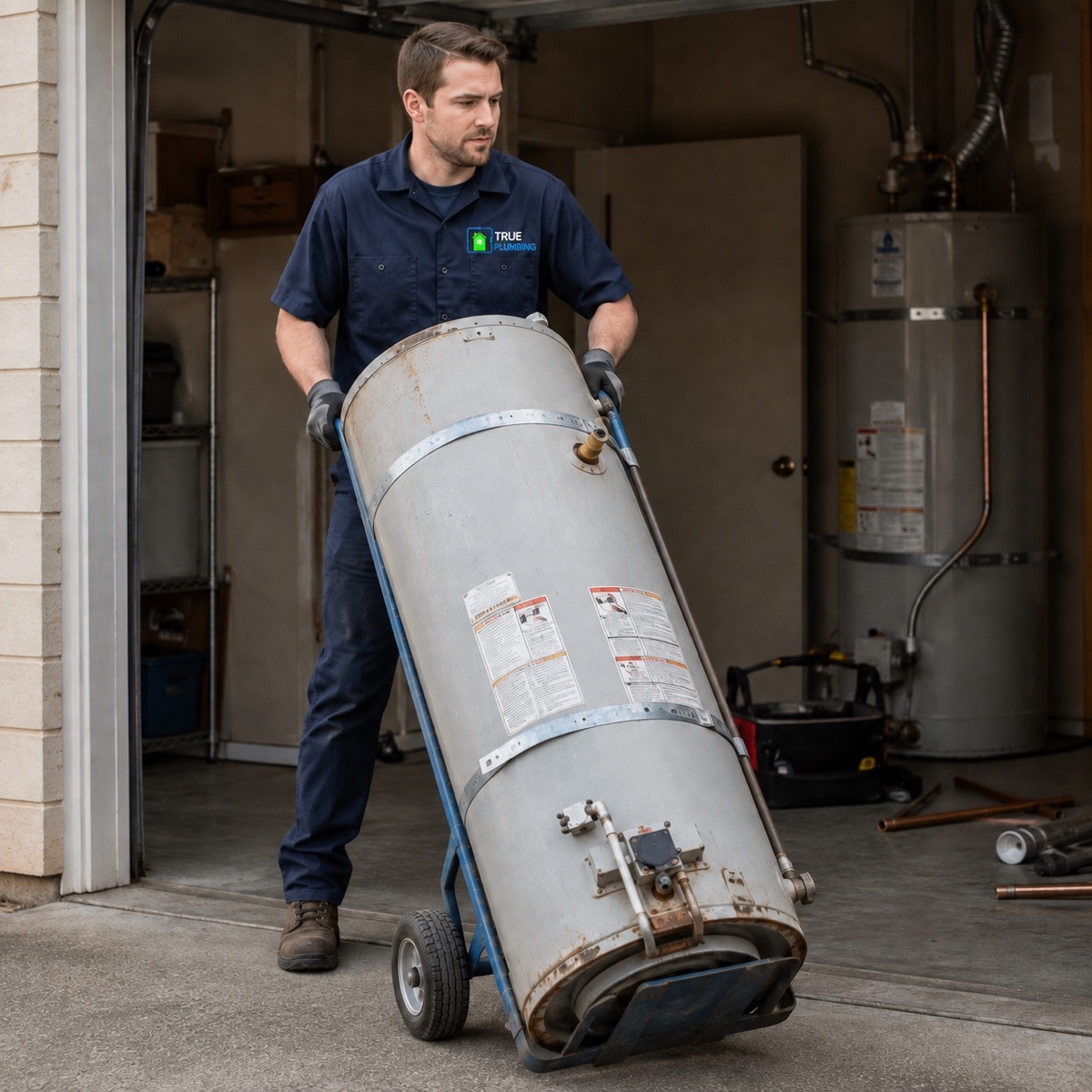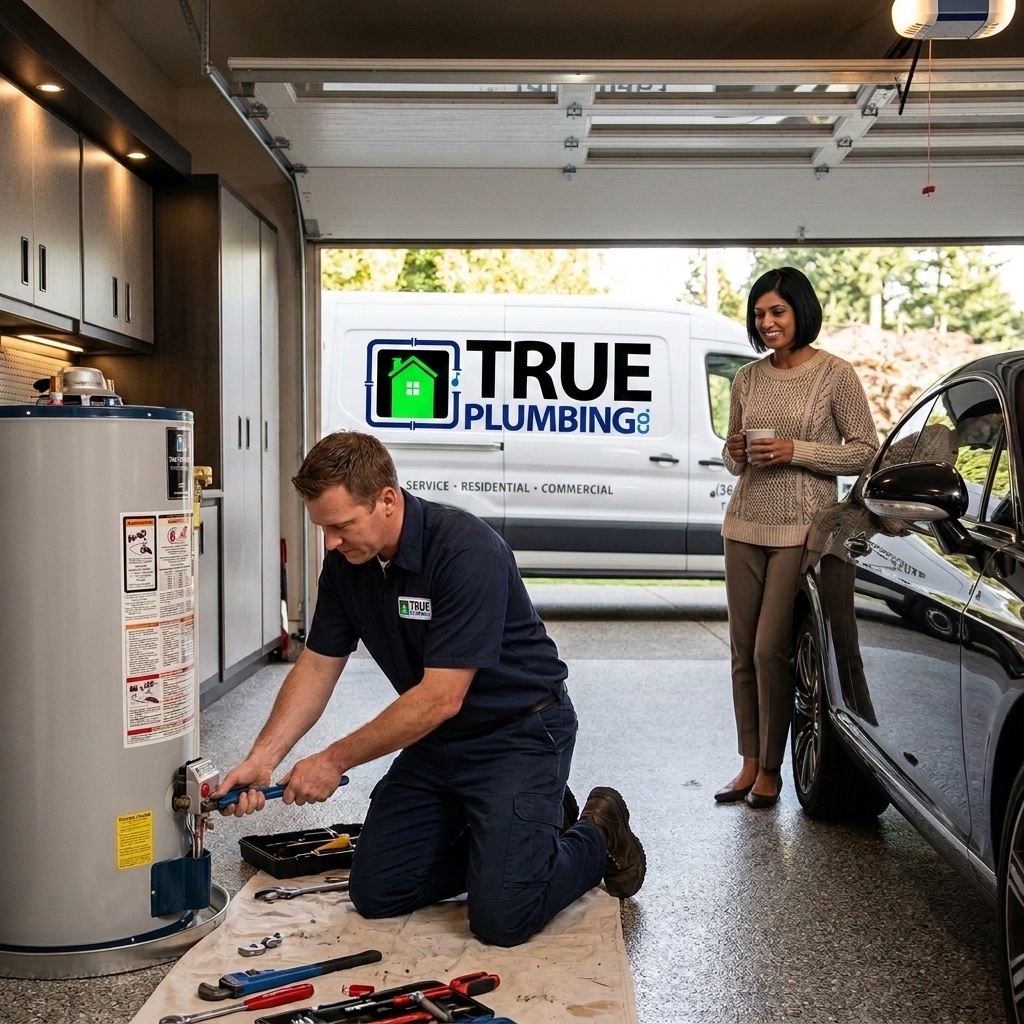
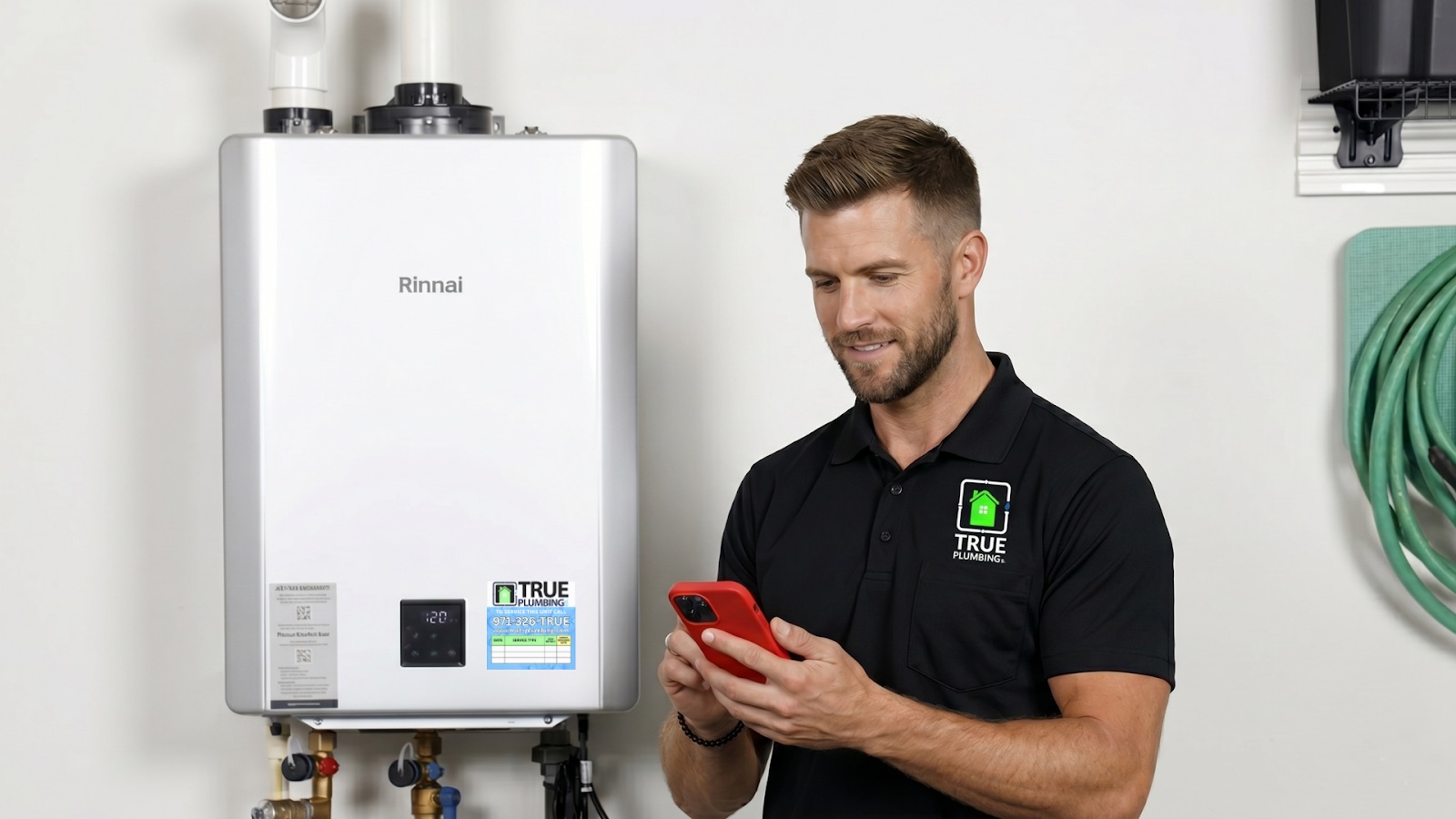
The right water-heater maintenance starts with one basic fact: what type of equipment is in the house. A conventional tank stores heated water. A tankless unit heats water as it passes through. A heat pump water heater stores water but also has an air filter, fan, compressor, and condensate drain. Giving all three the same “annual flush” treatment misses the parts most likely to need attention.
Before touching a valve or removing a panel, find the model number and the manufacturer’s use-and-care manual. The manual decides the safe shutdown, cleaning method, and service interval for that unit. The guide below helps Vancouver-area homeowners recognize what belongs on the list and what should be left to a plumber.
Start with the checks every water heater needs
Make a visual inspection part of routine home maintenance without removing a cover. Use a flashlight. Check the floor, drain pan, pipe joints, shutoff valve, and discharge pipe for water, rust tracks, mineral crust, or new staining. Listen for a new hiss, rumble, fan rattle, or repeated ignition attempt. Photograph any error code and compare it with the manual before taking another step.
Then compare the hot water with the way the system normally behaves. A longer recovery time, temperature swings, less usable hot water, or a sudden increase in noise is more useful to a technician than “it seems old.” Write down when the symptom started and whether it happens at every fixture.
Use the maintenance list for your equipment type
| Water heater | Homeowner checks | Common professional work |
|---|---|---|
| Storage tank | Look for leaks and corrosion; note noise, recovery time, and water-temperature changes; follow the manual’s flush instructions only when the drain and shutoff are sound. | Tank flush when appropriate, anode inspection, relief-valve assessment, burner or element testing, venting and combustion checks, expansion and pressure diagnosis. |
| Tankless | Record error codes; check the intake and exhaust area; clean a user-serviceable inlet screen only as the manual directs. | Model-approved descaling, combustion analysis, burner and heat-exchanger inspection, condensate service on condensing models, flow and temperature diagnosis. |
| Heat pump | Keep the air path open; clean the air filter on the model’s schedule; look for standing water and confirm the condensate line is draining. | Condensate-line service, tank and safety checks, electrical diagnosis, fan or compressor evaluation, installation-clearance and airflow correction. |
This table is a triage tool, not a universal procedure. Fuel type, installation, age, warranty, water conditions, and prior maintenance all change the safe scope.
Storage tank maintenance: flushing is only one part
Sediment can settle at the bottom of a storage tank and may contribute to noise or reduced performance. EPA WaterSense lists an annual flush as general guidance, but the manufacturer’s manual still controls. A neglected older tank, a brittle drain valve, a missing shutoff, or signs of tank corrosion can turn a routine flush into a leak. Those are good reasons to have the condition assessed before opening the drain.
If the manual describes a homeowner flush, follow its shutdown, draining, refill, and restart steps in order. Do not substitute a generic procedure for the instructions on the installed unit. If the valves, drain path, or sequence are unclear, leave the flush to a technician.
If the manual includes sacrificial-anode inspection, use its interval and replacement criteria. Access and procedure vary by model and installation, so this is a reasonable item to ask about during professional service rather than assuming it is a homeowner task.
The temperature-and-pressure relief valve is a safety device. EPA WaterSense includes checking it in general maintenance guidance, but the installed unit's manual controls the procedure. If the valve or discharge pipe is already leaking, stop and have it evaluated instead of attempting a routine test.
Tankless maintenance: diagnose before descaling
Tankless equipment can collect mineral scale inside the heat exchanger, but a generic vinegar flush is not automatically correct. The cleaning solution, isolation-valve sequence, pump setup, and interval are model-specific. Use the installed model's maintenance instructions rather than a one-size-fits-all recipe.
Start with the easy information: model number, displayed code, inlet-water screen condition, and whether the problem happens at one faucet or throughout the house. A low-flow fixture, crossover, dirty inlet filter, ignition problem, or vent restriction can resemble scale. Descaling the unit will not fix those causes.
Some tankless maintenance is user-serviceable and some is not. Stay within the steps the manufacturer labels for the owner. If the procedure requires removing a service cover or working on gas, venting, or electrical components, use a qualified technician.
Heat pump water heater maintenance: protect the air side
A heat pump water heater needs ordinary tank checks plus maintenance on the parts that move heat from the surrounding air. ENERGY STAR identifies air-filter cleaning and condensate-line cleaning as common routine tasks. Its general guidance calls for filter cleaning every six to twelve months, more often in dusty spaces, and condensate-line cleaning each year. The installed model’s manual takes priority.
Keep stored boxes, laundry, and dust from blocking the intake or exhaust. A restricted air path can reduce performance. Clean only the filter areas the manual identifies as user-serviceable. Standing water in a lower drain pan can point to a condensate blockage or a plumbing leak; it should not be ignored.
Also pay attention to a change in fan noise, longer recovery, or frequent use of electric-resistance mode. Those symptoms can reflect demand settings, a dirty filter, colder surrounding air, an installation issue, or a component fault. They are clues, not a diagnosis.
What Vancouver water data can and cannot tell you
Vancouver’s 2025 water-quality report lists system-wide hardness results from 55 to 130 parts per million. That range helps explain why scale may differ by location and operating conditions, but it does not reveal the hardness at one home on one day. It also does not create one correct maintenance interval for every tankless unit or storage tank.
If scale is heavy, compare the heater manual with an on-site water reading and the equipment’s service history. A private well or a property outside the City system needs its own evidence. Maintenance should respond to the actual water and actual model, not a broad assumption about all of Clark County.
Prepare for a useful service call
A few details can turn a vague request into a focused diagnosis. Before calling, photograph the full unit, model-and-serial label, nearby piping, any leak or staining, and the error display. Note the fuel or power source, the unit’s approximate age, what maintenance has been done, and whether the symptom affects the whole house.
If the main concern is water on the floor, use the separate guide to reduce water-heater leak and flood risk. If repairs are becoming frequent, compare the specific failure, tank condition, warranty, and replacement cost in the water heater repair-or-replace guide.
- Call promptly for active water: describe where the water appears and whether it is reaching nearby equipment. Stop the maintenance attempt.
- Preserve the evidence: photograph the displayed code and note what happened before it appeared.
- Ask for the scope: confirm whether the visit is inspection, maintenance, repair, or a combination, and whether the technician services that exact equipment type.
When a unit is leaking, losing hot-water capacity, showing a recurring code, or making new combustion or electrical symptoms, maintenance may no longer be the right category. True Plumbing can diagnose common tank and tankless water-heater problems in the Vancouver area. For a heat pump model, call first with the model number so the team can confirm current equipment and service availability. Review the water heater repair service or call (360) 207-6064.