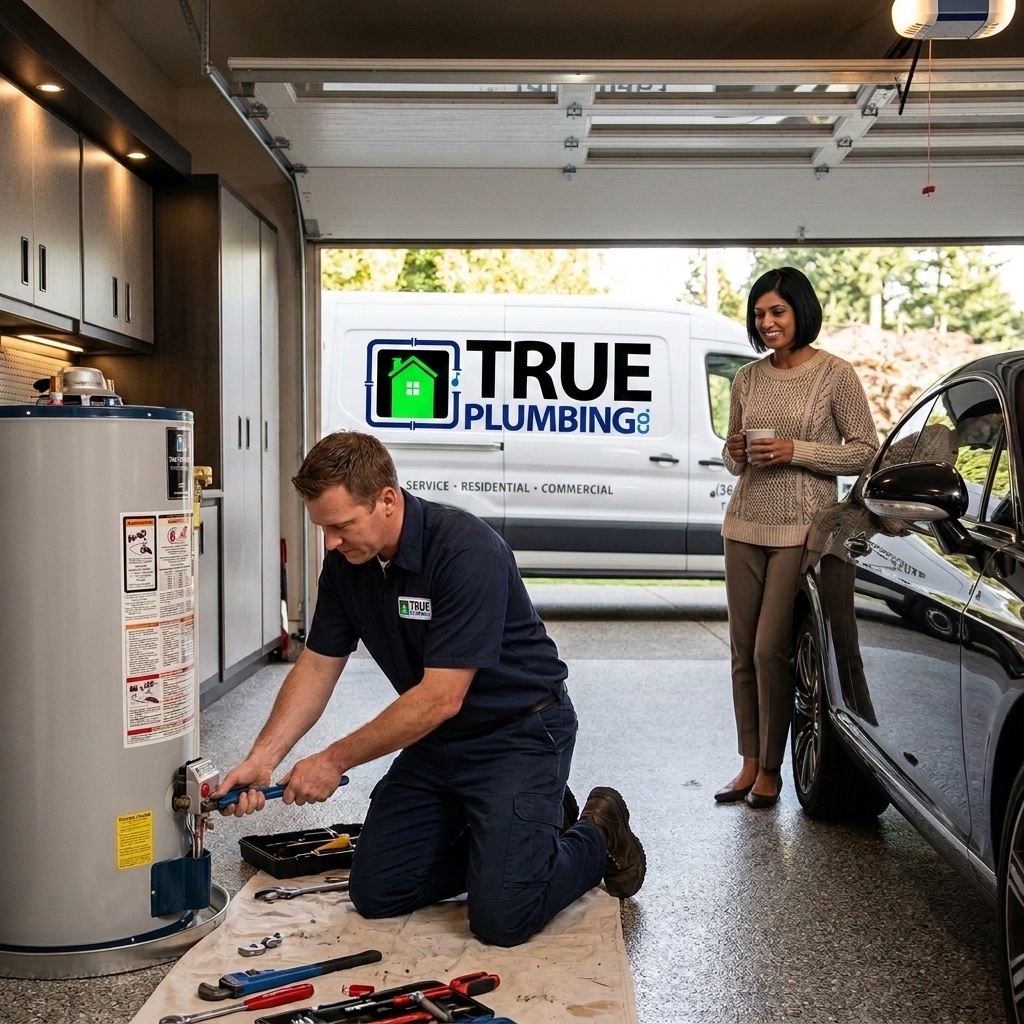
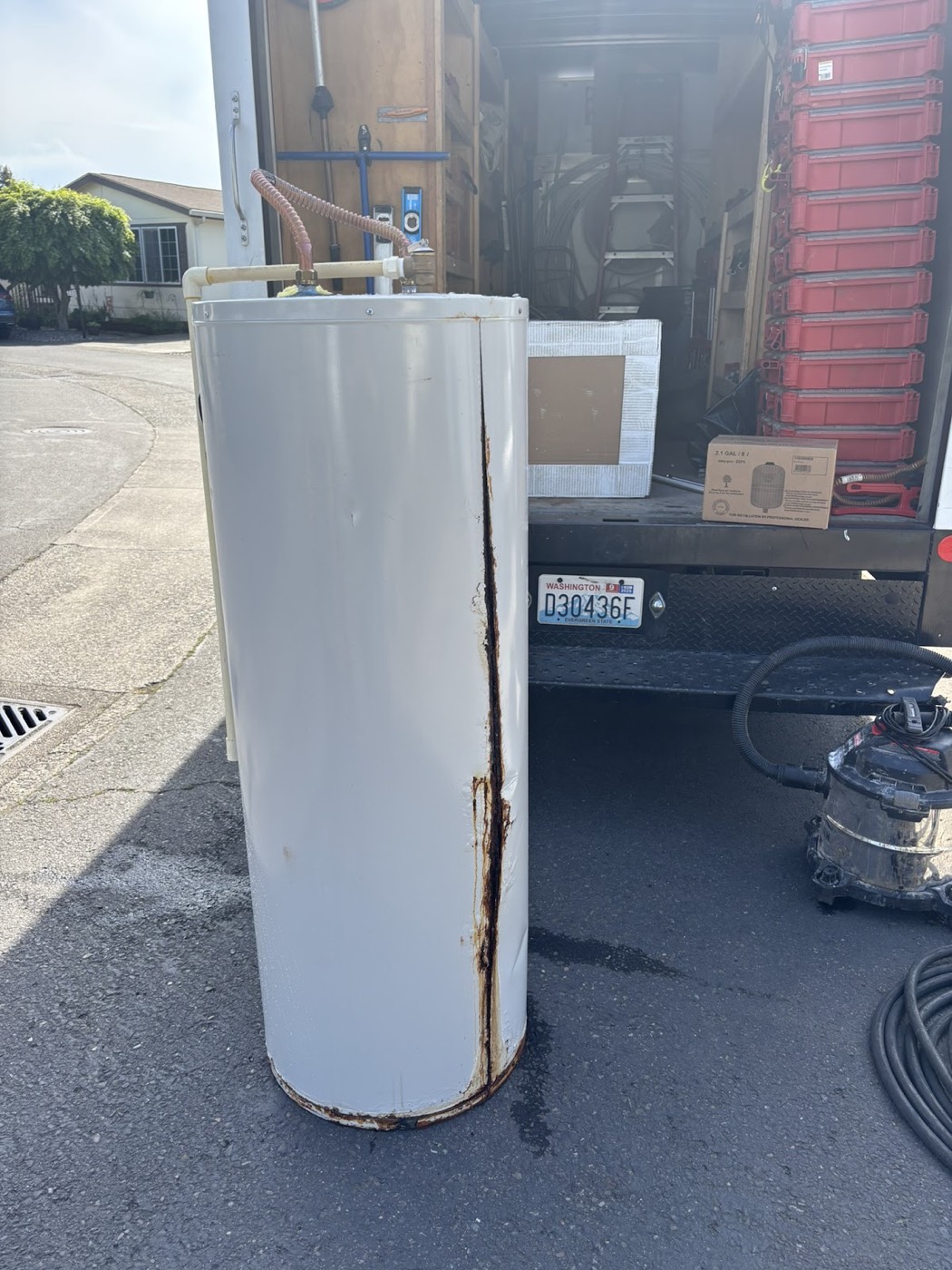
A water heater does not need to be replaced just because the water runs cold. Failed heating elements, thermostats, igniters, gas control valves, and other individual parts can often be repaired while the tank itself remains sound. The decision changes when the tank leaks, corrosion is advanced, or the cost of another repair is too close to the cost of a properly installed replacement.
For most Vancouver, WA homeowners, the best answer comes from the location of the failure, the age and condition of the tank, the warranty, the repair-to-replacement cost, and any water or pressure conditions that may be shortening the equipment's life.
The short version:
- Repair usually makes sense when the unit is relatively young, the tank is dry and structurally sound, and one replaceable part has failed.
- Replacement usually makes sense when the tank itself leaks, hot water stays rusty, repairs keep repeating, or the unit is near the end of its expected life and the repair is expensive.
- Age is evidence, not a verdict. A plumber should diagnose the failure before recommending either path.
- On a private well, premature corrosion or repeat failures are a reason to test the water and assess the system before installing another water heater.
If the problem appears repairable, True Plumbing's water heater repair service covers gas and electric, tank and tankless equipment across Vancouver and Clark County. If the tank or the economics point toward replacement, the water heater replacement and installation page explains the available paths.
The failed component matters more than age alone
Two water heaters of the same age can need completely different solutions. A six-year-old tank with a failed thermostat may need a straightforward repair. Another six-year-old tank that is leaking through the steel shell needs replacement because changing a thermostat will not repair a corroded pressure vessel.
Problems that are often repairable
No hot water does not automatically mean the unit is finished. On an electric water heater, a thermostat or heating element may have failed. On a gas model, the problem may involve the igniter, thermocouple, burner assembly, or gas control valve. A loose connection, drain valve, or temperature and pressure relief valve can also leak even when the tank remains usable.
Those are repair candidates, not promises. The plumber still needs to confirm that the tank is sound, the correct part is available, and no separate safety or installation problem is present.
Problems that usually point to replacement
Water coming through the tank body or collecting at the base after fittings and valves have been ruled out is a different kind of failure. The tank itself is not field-repairable. Persistent rusty hot water can also indicate internal tank corrosion, especially when the cold water from the same faucet runs clear.
Replacement also deserves serious consideration when one repair follows another. A new part can fix today's failed component, but it does not reset the age of the tank, heat exchanger, burner, wiring, or controls around it.
Use age as context, not as an automatic cutoff
Rheem's homeowner guidance puts the typical life of a traditional tank water heater at about 8 to 12 years and a tankless water heater at about 15 to 20 years or more with proper care. Those are planning ranges, not expiration dates. Water quality, installation, household demand, maintenance, and operating conditions can move the outcome in either direction.
The age of the unit becomes more useful when paired with its condition:
- A five-year-old tank with one failed heating element is usually worth diagnosing for repair.
- An 11-year-old tank with a dry base, no visible corrosion, and an inexpensive isolated failure may still be repairable.
- An 11-year-old tank with rust, a base leak, or several recent service calls is a much stronger replacement candidate.
If you do not know the age, take a clear photo of the model and serial number on the rating plate. The manufacturer or a plumber can use that information to identify the manufacture date and check whether a parts or tank warranty may still apply. Warranty coverage can materially change the repair-versus-replacement calculation.
Clark County well water can change the calculation
For homes on private wells around Amboy, Yacolt, Hockinson, Brush Prairie, and elsewhere in north Clark County, Tyler Toivonen, founder of True Plumbing, cautions against assigning one water-heater lifespan to every well. A well is specific to the property, and its water can change over time. That is why there is no honest universal comparison that says a water heater on a well will last a certain number of years while one on Vancouver city water will last another.
Many local well systems use a pressure switch that operates around 40 to 60 psi: the pump starts near the low end and stops near the high end. That is a common setup, not a guarantee for every home. Once the actual pressure is confirmed, water chemistry becomes another important part of the diagnosis.
In True Plumbing's field experience, acidic or alkaline water conditions are a recurring concern in Clark County. Water chemistry outside the appropriate range can contribute to corrosion, scale, and premature wear in water heaters, copper piping, and fixtures. Tyler's advice is direct: Without a test, there's no possible way to know
what a particular well needs.
This matters when a heater shows corrosion unusually early or keeps losing components. Before replacing it with the same type of unit, have the well water tested and the pressure and plumbing system assessed. A neutralizing system may be appropriate for some confirmed water conditions, but it should follow the test results rather than serve as a default prescription. When testing identifies a condition worth treating, True Plumbing can explain the appropriate water-filtration options.
Look closely at the symptom before choosing a path
There is no hot water
No hot water often begins as a diagnostic call, not a replacement order. A failed electric element, thermostat, igniter, or control may be replaceable. The case for repair is strongest when the unit is younger, the tank is dry, and this is the first significant failure.
Hot water runs out faster than it used to
A failing lower element, thermostat problem, sediment buildup, or a change in household demand can reduce usable hot water. A repair or maintenance visit may restore performance. If the unit is undersized for the people now living in the home, replacement may solve a capacity problem that a new part cannot.
Water is collecting around the heater
The source matters. Water can come from a fitting, drain valve, relief valve, condensation, or the tank. Some fitting and valve leaks are repairable. A leak through the tank body generally means replacement.
If water is spreading, shut off the water supply to the unit and its energy source only if you can do so safely and know the correct procedure. Do not touch electrical equipment while standing in water. True Plumbing's guide to preventing water heater leaks and flooding explains what to inspect before a small leak becomes a larger loss.
Hot water looks rusty or discolored
Compare hot and cold water at the same faucet. If both are discolored, the source may be upstream of the water heater. If only the hot water is consistently rusty, the anode rod or tank may be involved. An anode rod can sometimes be replaced before tank corrosion advances. Once the tank itself has corroded, replacement is the practical path.
The tank rumbles, pops, or bangs
Noise often points to sediment at the bottom of a tank, but noise alone does not decide the job. A younger, otherwise healthy unit may benefit from service. A noisy older tank with poor recovery, corrosion, or a history of neglected maintenance deserves a replacement evaluation. Do not assume that an aggressive flush is safe for every old tank. Follow the manufacturer's instructions and have the condition assessed first.
A gas odor or carbon monoxide alarm is present
This is not a repair-versus-replacement decision to make inside the home. Leave the area immediately and call 911 and the gas utility from a safe location. NW Natural's current emergency number is 800-882-3377. Do not search for the source, operate switches, or return until emergency responders say it is safe.
Compare the full repair price with the full replacement scope
A repair estimate and a replacement estimate answer different questions. The repair estimate should identify the failed part, labor, warranty, and any other condition likely to affect the result. The replacement estimate should include the equipment, labor, permit, disposal, and required changes to venting, drainage, seismic restraint, gas, or electrical service.
Rheem describes the 50% rule as a useful rule of thumb: when a repair costs more than half the price of a new water heater, replacement is often the better investment. That threshold is not a law. It becomes more persuasive when the unit is already near the end of its expected life, has a weak warranty, or has needed multiple repairs.
Ask these questions before approving either job:
- What exactly failed, and is the tank itself sound?
- Is the failed part covered by a manufacturer warranty?
- How much have I spent on this unit during the past two years?
- What is included in the installed replacement price?
- Will the replacement require venting, gas-line, drain, panel, circuit, or space changes?
- Does the existing size still match the household's peak hot-water demand?
The cheapest immediate option is not always the lowest-cost decision. A modest repair on a healthy unit can be an excellent use of money. A large repair on an old, corroded, undersized unit can delay the same replacement by only a short time.
Replacement is a chance to correct the old system's weaknesses
When replacement wins, do not automatically buy the same gallon count and fuel type without checking the home. The right equipment depends on peak hot-water use, available fuel, installation space, venting, electrical capacity, noise, recovery needs, and the total installed cost.
A standard tank replacement
A same-fuel tank replacement is often the simplest option when the old unit met the household's needs and the installation area is suitable. Size the new model by its first-hour rating and household demand instead of relying on the number printed on the tank. True Plumbing has a dedicated page for tank water heater installation and replacement in Vancouver.
A tankless water heater
Tankless equipment can reduce standby losses and provide long runs of hot water, but it must be sized for simultaneous flow and the required temperature rise. Gas supply, venting, maintenance, and installation cost all matter. Review the real advantages and limits of tankless water heaters before treating tankless as an automatic upgrade.
A heat pump water heater
For homes replacing a standard electric resistance water heater, a heat pump water heater may reduce energy use by moving heat from the surrounding air into the tank. It also needs adequate installation space and air volume, and homeowners should consider sound, condensate drainage, recovery, and the temperature of the installation area.
Clark Public Utilities currently lists a heat pump water heater program for qualifying customers. Confirm the current equipment requirements, existing-water-heater rules, and rebate availability before purchasing a unit. Incentives can change and should not be counted until eligibility is verified.
Four common Vancouver homeowner scenarios
These examples show how the factors work together. They are not substitutes for an on-site diagnosis.
A young electric tank suddenly stops heating
The tank is dry, the hot water is clear, and there have been no previous repairs. This starts on the repair side of the decision. A failed element or thermostat may restore full service without replacing the unit.
An older tank leaks from the bottom
Water is coming through the tank body rather than a visible fitting. The tank has failed, regardless of whether the burner or elements still work. Replacement is the appropriate path.
A nine-year-old unit needs an expensive second repair
The current repair may be technically possible, but the age, recent repair history, remaining warranty, and repair-to-replacement ratio all matter. If the repair approaches half the installed replacement price, putting the money toward a new unit may be the stronger financial choice.
A tankless unit shows an error code after years without service
An error code does not automatically mean the heat exchanger is finished. Scale, a dirty filter, ignition problems, sensors, or controls may be involved. Diagnose and service the unit before assuming it needs replacement, then compare the repair with the unit's age and maintenance history.
What to gather before the plumber arrives
Take photos of the rating plate, the full installation, and any leak or corrosion. Note whether the problem affects all hot-water fixtures, when it started, whether the breaker tripped or an error code appeared, and what repairs have already been made. Keep the area accessible, but do not remove covers or attempt gas, electrical, or relief-valve work unless the manufacturer's instructions specifically authorize a homeowner check.
For a unit that remains in service, use a maintenance plan based on the manufacturer's manual and the actual equipment. True Plumbing's water heater maintenance guide covers the role of tank flushing, anode-rod inspection, and tankless descaling.
Get the diagnosis before committing to the answer
The repair-versus-replacement decision should be explainable in plain language. The plumber should be able to show where the failure is, whether the tank is sound, what the repair includes, and what would change with replacement.
True Plumbing can diagnose the unit and quote the appropriate path for Vancouver and Clark County homeowners. If the failure is isolated, start with water heater repair. If the tank has failed or replacement offers the better value, review the water heater replacement and installation options. Call (360) 207-6064 to confirm current availability.
Water heater repair vs. replacement FAQs
Is it worth repairing a 10-year-old water heater?
Sometimes. A modest repair may make sense when the tank is dry, corrosion is limited, the part is available, and the rest of the unit is in good condition. Replacement becomes more attractive when the tank leaks, hot water is persistently rusty, repairs are repeating, or the repair cost approaches half the installed replacement price.
Can a leaking water heater be repaired?
It depends on the source. A fitting, drain valve, or relief valve may be repairable. A leak through the steel tank generally requires replacement. Water at the base should be assessed promptly because the source is not always visible from the front of the unit.
How long do water heaters usually last?
Rheem's guidance describes about 8 to 12 years for traditional tank water heaters and about 15 to 20 years or more for tankless units with proper care. Installation, demand, water quality, and maintenance can shorten or extend those ranges.
What is the 50% rule for water heater replacement?
It is a rule of thumb that favors replacement when the repair price exceeds half the cost of a new unit. Use the complete installed replacement price for the comparison, and weigh the result alongside age, tank condition, warranty, and repair history.
Should I replace my water heater before it fails?
Planned replacement can make sense when an older unit shows corrosion, declining performance, or repeated problems, especially when a leak would damage finished space. A functioning older unit does not need automatic replacement, but planning ahead gives you time to compare equipment, installation requirements, and current utility incentives.